

Hydrotherapy research: what warm baths and jets have really been shown to do
Direct answer: the best evidence is for warm water, not jets. A Cochrane review found that exercising in warm water brings small, short-term improvements in knee and hip arthritis pain, about 5 points on a 100-point scale. A meta-analysis found a warm bath 1 to 2 hours before bed helps people fall asleep sooner. Studies link regular hot bathing to healthier blood vessels and, in one large Japanese cohort, fewer heart attacks and strokes, but those are not proof of cause. We found no controlled trials of jets in a home walk-in tub. Choose jets for comfort, not as a treatment.
Reviewed October 15, 2026. Every study below was read in its published abstract; full citations are listed at the end.
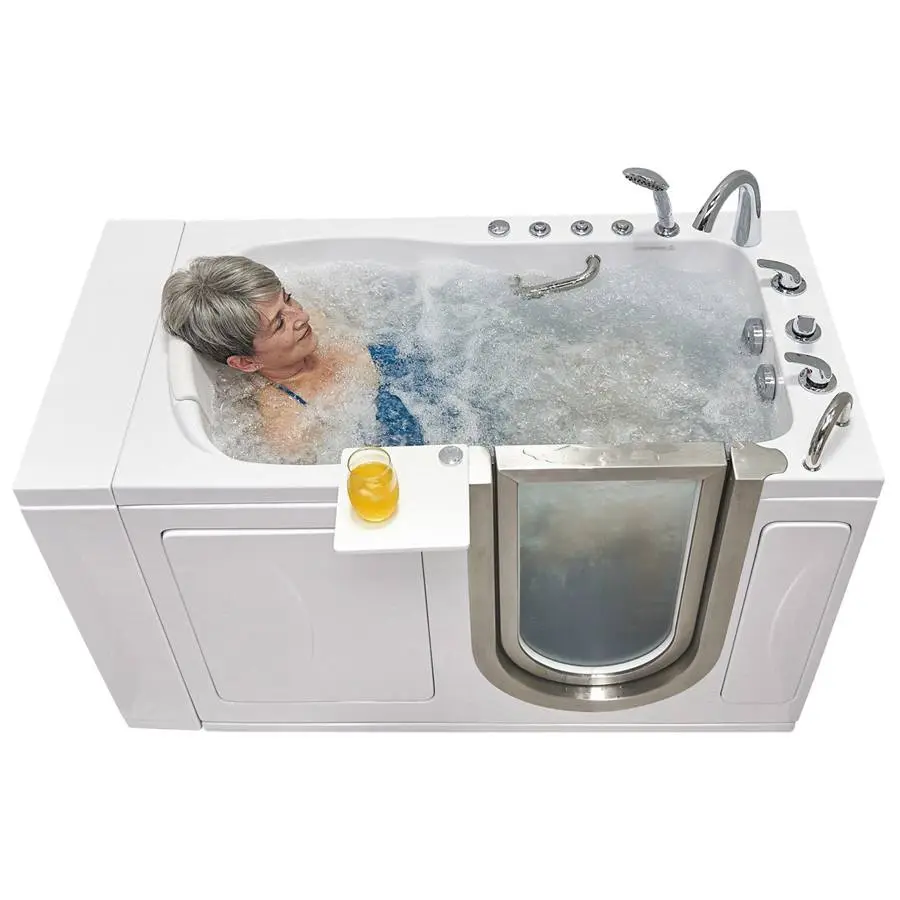
Hydrotherapy covers a lot of ground: exercise in a heated pool, soaking in mineral springs, a hospital whirlpool for a stiff hand, a hot bath at home. Most research is about the first three. A walk-in tub with jets is the last one, with massage added. So the honest question for each study is: does this apply to sitting in warm water at home?
The evidence at a glance
| Claim | Best evidence we found | How strong | Applies to a walk-in tub? |
|---|---|---|---|
| Eases knee and hip arthritis | Cochrane review, 13 trials, 1,190 people (aquatic exercise) | Moderate small effect | Partly: those trials involved exercise, not just soaking |
| Eases rheumatoid arthritis | Cochrane review, 9 trials, 579 people (spa and bath therapy) | Low mostly unclear | Weakly: many used mineral or radon baths |
| Helps you fall asleep | Meta-analysis of 13 studies (warm bath or shower before bed) | Moderate small studies | Yes: a warm bath is a warm bath |
| Helps leg veins (chronic venous insufficiency) | Cochrane review, 9 trials, 1,126 people | Moderate slight benefit | Partly: mostly spa-based programs |
| Better blood vessel function | Small 8-week trials (20 and 19 people) | Early promising | Not directly: hotter and longer than safe at home |
| Fewer heart attacks and strokes | Japanese cohort, 30,076 adults over about 20 years | Observational association only | Unclear: daily bathers may differ in other ways |
| Jets add benefit beyond warmth | No home-tub trials found; one clinic whirlpool trial for a hand condition | Very little | Unknown |
Arthritis and joints
Aquatic exercise for knee and hip osteoarthritis (Cochrane, 2016)
What it looked at: 13 randomized trials, 1,190 people with an average age of 68, mostly women, exercising in water for about 12 weeks.
What it found: a small, short-term improvement in pain and disability, about 5 points lower on 100-point scales, and about 7 points better on quality of life. No serious side effects were reported. The authors rated the evidence moderate quality.
What it does not show: these people were moving in a pool, not sitting in a tub. Warmth and buoyancy probably helped, but the exercise was part of the treatment.
| Outcome (0–100 scale) | Average improvement | 95% range |
|---|---|---|
| Pain | 5 points lower | 3 to 8 |
| Disability | 5 points lower | 3 to 8 |
| Quality of life | 7 points higher | 0 to 13 |
Spa and bath therapy for rheumatoid arthritis (Cochrane, 2015)
What it looked at: 9 trials with 579 people, testing mud packs, mineral and radon baths, and seated immersion.
What it found: most studies had an unclear risk of bias, four reported no usable data, and most comparisons showed no clear difference. The one trial of plain seated immersion against water exercise, land exercise or relaxation found no significant difference in pain.
The takeaway: there is not enough good evidence to say bathing treats rheumatoid arthritis. It may still feel good, and that matters, but it is not a treatment.
Sleep
A warm bath before bed (Sleep Medicine Reviews, 2019)
What it looked at: 17 studies of warm showers or baths before bedtime, 13 of them pooled.
What it found: water at 40 to 42.5°C (104 to 108.5°F) taken 1 to 2 hours before bed, for as little as 10 minutes, shortened the time it took to fall asleep and improved self-rated sleep quality. The likely reason is that warming the skin helps the body shed heat afterward, and a falling core temperature signals sleep.
The catch: the studies were small, and those temperatures sit above what we suggest for older bathers. A warm bath that ends an hour or two before bed still uses the same idea.
Heart and blood vessels
Habitual tub bathing and heart disease (Heart, 2020)
What it looked at: 30,076 Japanese adults aged 40 to 59, followed from 1990 to 2009.
What it found: people who bathed in a tub almost every day had a 28% lower risk of cardiovascular disease than those who bathed twice a week or less (hazard ratio 0.72), after adjusting for the usual risk factors.
What it does not show: it is observational. People who can take a hot bath every day may be healthier, wealthier or less stressed in ways no adjustment captures.
Eight weeks of hot water immersion (Journal of Physiology, 2016)
What it looked at: 20 young, sedentary adults; half soaked in 40.5°C (105°F) water 4 to 5 times a week for 8 weeks, long enough to hold core temperature at 38.5°C or more for an hour.
What it found: better artery function (flow-mediated dilation roughly doubled), less arterial stiffness and lower diastolic blood pressure than the comparison group.
Do not copy it at home. That protocol is hotter and longer than the 104°F spa maximum and far beyond what older adults should try in a tub. It shows a mechanism, not a home routine.
Home heat therapy in older adults (Journal of Applied Physiology, 2025)
What it looked at: 19 adults averaging 67 years old who wore water-heated trousers for an hour, four days a week, for eight weeks.
What it found: daytime systolic blood pressure fell by about 5 points in the heat group and did not change in the sham group, and artery function improved.
Why it is here: it is one of few heat studies in people of walk-in tub age. It used heated clothing, not a bath, so it hints at, but does not prove, a benefit for bathers.
Jets and microbubbles specifically
This is where the evidence runs out. Searching the medical literature for hydromassage, whirlpool baths and underwater jet massage, we found no randomized trials of jets in a home bathtub for arthritis, back pain, circulation or sleep.
The closest example: whirlpool baths for a painful hand (Journal of Physical Therapy Science, 2015)
60 outpatients with complex regional pain syndrome of the hand received 15 sessions of either a clinic whirlpool bath or electrical muscle stimulation. Both groups improved; the whirlpool group improved more in pain, swelling, grip and wrist motion. It is a small trial of a different condition and a different device, with no untreated comparison group, but it is real evidence that moving warm water can help some people.
Microbubble therapy is newer still. The claims about cleaner, softer or better-hydrated skin come mainly from manufacturers, and we found no independent controlled trials of home microbubble baths. That does not mean it does nothing; it means no one has measured it well yet.
Put plainly: jets are a comfort feature. Many people love them, and enjoying the bath is a good reason to take one. But warmth, safe entry and a bath you will actually use regularly matter more than the jet count. Our air vs water jet guide helps you choose by feel.
The risk side
The same heat that helps can hurt. After two 30-minute soaks at 39°C, blood pressure dropped on standing in 94% of middle-aged adults in a 2023 study, and Japan records thousands of bathtub drownings among older adults each year. Our page on who should not use jets covers those risks and the warnings in the manuals.
How to read health claims about jetted tubs
- “Relieves arthritis” usually traces back to warm-water exercise or spa programs, not to sitting in a tub with jets.
- “Improves circulation” is true in the short term (warm water widens blood vessels) and promising in small trials, but there is no trial of walk-in tub jets for circulation problems.
- “Clinically proven” should come with a study you can look up. Ask the seller for the citation.
- “Cures” anything is a red flag. No study we found supports it.
Want a second opinion on a jetted tub?
Tell us about your bathroom and what hurts. A specialist from Aging Safely Baths will give you an honest written quote. There is no deadline and no pressure, and you are welcome to compare us with anyone.
Questions people ask
Is hydrotherapy in a walk-in tub proven to help arthritis?
Not specifically. Warm-water exercise has moderate-quality evidence of a small short-term benefit for knee and hip arthritis. Sitting in a jetted tub at home has not been tested in trials, though the warmth is likely to ease stiffness for many people.
Do jets work better than a plain warm bath?
No study we found compared them in a home tub. One small clinic trial found whirlpool baths helped a painful hand condition more than electrical stimulation. For most people the honest answer is that jets add comfort and massage; the warmth does most of the work.
Can a warm bath help me sleep?
Probably. A 2019 meta-analysis found a warm bath or shower 1 to 2 hours before bed, even for 10 minutes, helped people fall asleep sooner. The studies were small, and older bathers should keep the water at a safe temperature.
Is microbubble therapy backed by research?
We found no independent controlled trials of home microbubble baths. The skin claims come mainly from manufacturers. It may feel pleasant; treat it as a comfort option rather than a treatment.
Sources
- Bartels EM, Juhl CB, Christensen R, et al. Aquatic exercise for the treatment of knee and hip osteoarthritis. Cochrane Database of Systematic Reviews 2016, CD005523. doi:10.1002/14651858.CD005523.pub3
- Verhagen AP, Bierma-Zeinstra SM, Boers M, et al. Balneotherapy (or spa therapy) for rheumatoid arthritis. Cochrane Database of Systematic Reviews 2015, CD000518. doi:10.1002/14651858.CD000518.pub2
- de Moraes Silva MA, Nakano LC, Cisneros LL, Miranda F. Balneotherapy for chronic venous insufficiency. Cochrane Database of Systematic Reviews 2023, CD013085. doi:10.1002/14651858.CD013085.pub3
- Haghayegh S, Khoshnevis S, Smolensky MH, et al. Before-bedtime passive body heating by warm shower or bath to improve sleep: a systematic review and meta-analysis. Sleep Medicine Reviews 2019;46:124–135.
- Ukai T, Iso H, Yamagishi K, et al. Habitual tub bathing and risks of incident coronary heart disease and stroke. Heart 2020;106:732–737.
- Brunt VE, Howard MJ, Francisco MA, et al. Passive heat therapy improves endothelial function, arterial stiffness and blood pressure in sedentary humans. Journal of Physiology 2016;594:5329–5342.
- Ruiz-Pick YI, Cope HL, Richey RE, et al. Home-based heat therapy lowers blood pressure and improves endothelial function in older adults. Journal of Applied Physiology 2025;138:979–987.
- Devrimsel G, Turkyilmaz AK, Yildirim M, Beyazal MS. The effects of whirlpool bath and neuromuscular electrical stimulation on complex regional pain syndrome. Journal of Physical Therapy Science 2015;27:27–30.
- Steward CJ, Menzies C, Clarke ND, et al. The effect of age and mitigation strategies during hot water immersion on orthostatic intolerance and thermal stress. Experimental Physiology 2023;108:554–567.
- Tai Y, Obayashi K, Yamagami Y, Saeki K. Drowning and submersion deaths in bathtubs and associated factors in Japan, 1995–2020. Journal of Epidemiology 2025;35:482–489.